It is a cold Buffalo evening. The laundry basket is full. The dryer hums, the drum turns and the timer counts down. An hour later, you open the door to a pile of cold, wet towels. No smell of warm cotton. No heat at all.
A dryer not heating is one of the most common calls our appliance repair team gets. It is also one of the most fixable. The drum still spins, which tells you the motor and belt are fine. Something in the heat side has stopped.
In most homes, a dryer not heating comes down to a tripped breaker, a blown thermal fuse, a dead heating element or a failed gas igniter. Very often, a clogged vent is what caused the part to fail in the first place.
In this guide, you will find:
- Five free checks to try before you call anyone
- The usual causes, split by electric and gas dryers
- Why the vent is behind so many heating failures
- Real repair price ranges, and when a new dryer makes more sense
Let’s start with the part most people never think about.
What Is Really Going On When You Find Your Dryer Not Heating?
A dryer stops heating when power or gas cannot reach the heat source. It also stops when a safety part shuts the heat off. Common causes are a tripped breaker and a blown thermal fuse. Electric models often have a bad heating element. Gas models often have a failed igniter or gas valve coil.
Think of the heat side as a chain. Power or gas comes in. Safety parts check that the dryer is not too hot. Then the heat source turns on. If any link breaks, the drum keeps turning but the air stays cold.
That is why swapping parts at random gets expensive. A new heating element will not help if the thermal fuse is open. Find the broken link first, then fix that one part.
How Do You Tell a Gas Dryer From an Electric One, and Why Does It Matter?
Look behind the dryer. A metal gas pipe with a shutoff valve means it is a gas dryer. A large plug in a big three or four prong outlet, with no gas line, means it is electric. The causes of no heat are different for each, so check this first.
Both types share a motor, drum, belt, thermostats and a thermal fuse. The heat source is what differs. An electric dryer uses a coiled heating element, like a giant toaster wire. A gas dryer uses a burner, an igniter and a gas valve.
Many older Buffalo homes have gas dryers in the basement. Newer apartments often have electric ones. Knowing which you have cuts the list of causes almost in half.
Which Free Checks Should You Try Before Calling a Repair Technician?
Check the heat setting, the breaker, the gas valve, the lint screen and the outside vent hood. These five checks are free and take about ten minutes. Together they solve a good share of calls about a dryer not heating, without any parts.
Work through them in order:
- Heat setting. Make sure the dryer is not set to Air Fluff, Air Dry or No Heat. It happens more than you would think, especially after a cleaning.
- Breaker. An electric dryer uses a double breaker. Flip it fully off, then back on, even if it looks fine.
- Gas valve. On a gas dryer, the handle on the supply line should run parallel to the pipe. If the dryer was moved recently, someone may have closed it.
- Lint screen. Pull it out and clean it. Hold it up to the light. If water does not pass through, wash it with warm soapy water to remove dryer sheet film.
- Outside vent hood. Run the dryer and step outside. You should feel strong, warm air at the hood. Weak or no airflow points to a clogged vent.
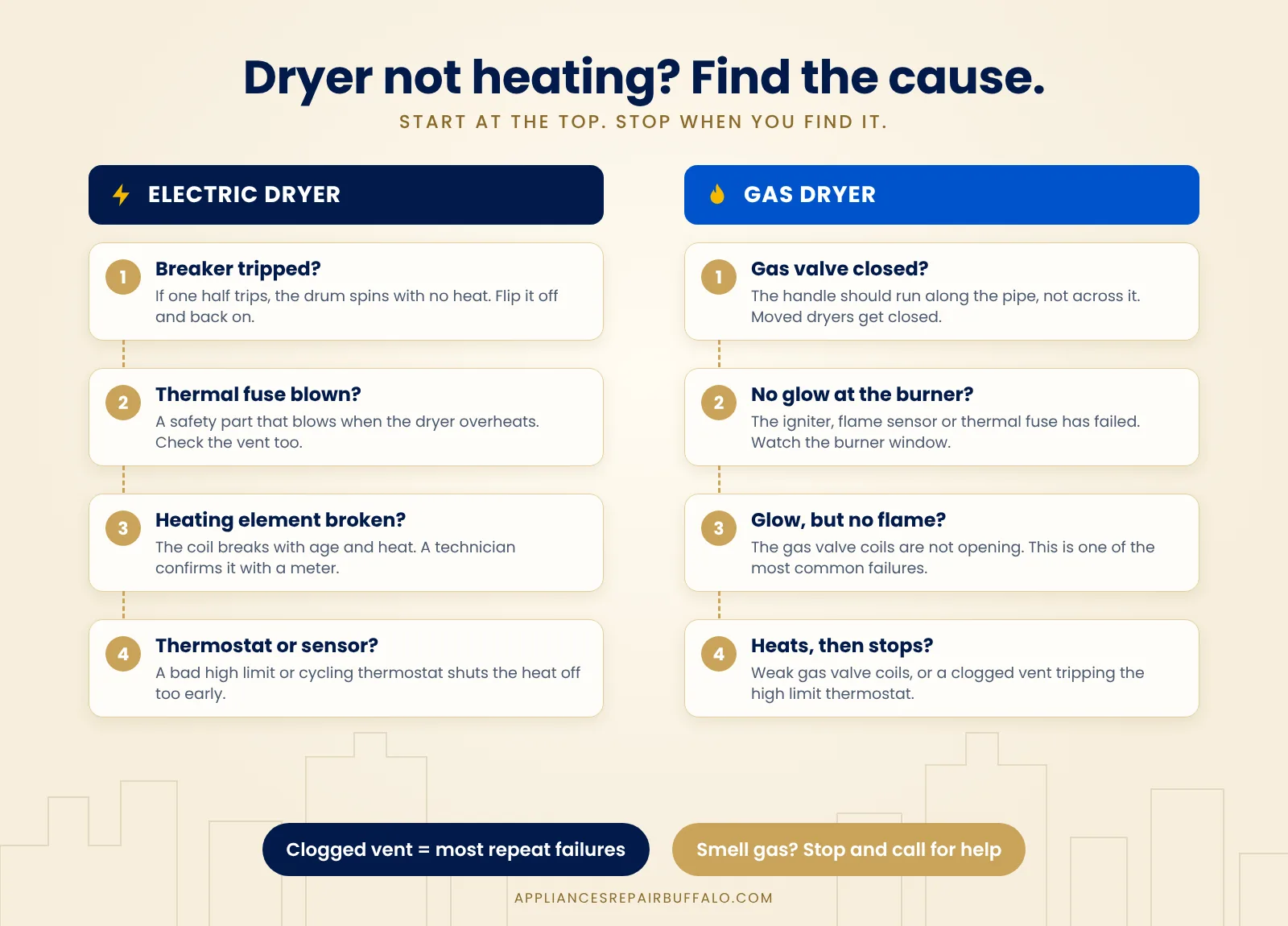
If all five look fine and the dryer still blows cold air, the problem is likely a part. Here is how to narrow it down.
Done with the five checks
A technician can find the failed part today
A $79 service call, credited to the repair. One clear price before any work starts.
What Stops an Electric Dryer From Heating While the Drum Still Spins?
An electric dryer not heating usually has a tripped breaker, a blown thermal fuse or a dead element. A failed high limit thermostat is another common one. Less often, the cycling thermostat, a temperature sensor or the control board is at fault.
Electric dryers run on 240 volts, split across two legs of 120 volts. The motor often needs only one leg. The heating element needs both. So when one half of the breaker trips, the drum spins happily but no heat comes out.
That makes the breaker the first suspect. If the reset does not help, the next suspects sit on the heater housing at the back. We test each part with a meter before replacing anything.
How Do You Know If the Heating Element in an Electric Dryer Has Burned Out?
A bad heating element is usually broken somewhere along the coil. A technician tests it with a multimeter for continuity. A good element reads a low resistance, often around 10 ohms. No reading at all means the coil is open and needs replacing.
Elements wear out with age, but airflow is the bigger enemy. When a vent is clogged, heat builds up around the coil. Over time, the wire thins and snaps. Sometimes you can even see the break.
A burned out element is one of the most common reasons an electric dryer goes cold. Replace it without fixing the vent, though, and the new one may fail early too. That is why we check vent airflow on every heating repair.
A word of caution. The element sits inside a live 240 volt circuit. If you are not comfortable working with meters and unplugged appliances, leave this test to a technician.
What Does a Blown Thermal Fuse Tell You About the Rest of Your Dryer?
A thermal fuse is a one time safety part. It blows when the dryer gets too hot, and it shuts off the heat or the whole dryer. A blown fuse almost always means airflow is restricted, usually by a clogged vent. Replacing the fuse alone is not a full fix.
Think of the thermal fuse as a smoke detector that cuts power. It does not cause the problem. It reacts to it. On some models, a blown fuse stops the heat but lets the drum run. On others, the whole dryer goes dead.
Here is the trap. A new fuse costs very little, so many people swap it and move on. If the vent stays clogged, the new fuse blows again, sometimes within days. Each time, the dryer ran hot enough to trip a safety part. That is a warning, not a nuisance.
Why Does a Gas Dryer Stop Heating When the Gas Supply Is Still On?
With a gas dryer not heating, check for a closed gas valve first. After that, look at the igniter, gas valve coils, flame sensor and thermal fuse. The igniter is the easiest place to start, because you can often watch it work.
Here is how gas heat works. When the dryer calls for heat, the igniter glows bright orange. The flame sensor notices the heat and tells the gas valve coils to open. Gas flows, and the burner lights with a soft whoosh.
If one step fails, the chain stops. That is good news, because the step where it stops tells you which part failed. You can see most of it through the small burner window near the bottom front of many gas dryers.
What It Means When the Igniter Glows but the Burner Never Lights
When the igniter glows and then goes out without lighting the gas, the gas valve coils are the likely cause. If the igniter never glows, the problem is usually the igniter, the flame sensor or a blown thermal fuse.
Use this quick guide:
| What you see at the burner | Most likely cause |
|---|---|
| No glow at all | Igniter, flame sensor or thermal fuse |
| Glow, then no flame | Gas valve coils |
| Flame lights, then goes out after a few seconds | Gas valve coils (often weak when warm) |
| Flame lights and stays on, but clothes stay damp | Clogged vent or a cycling thermostat |
| Smell of gas | Stop. Turn off the gas valve and call for help |
Gas valve coils often fail when they warm up. The dryer heats for a few minutes, then stops. It may work again after it cools down. This on and off pattern is a classic sign.
If you ever smell gas, do not keep testing. Close the supply valve, open a window and leave the room. Call the gas company from outside.
Gas dryers need extra care
Leave gas parts to a technician
We test the igniter, gas valve coils and vent, then quote one clear price.
Why Would a Dryer Heat for a Few Minutes and Then Go Cold?
A dryer that heats briefly then goes cold often has weak gas valve coils or a failing cycling thermostat. A clogged vent can also cause it. The extra heat trips the high limit thermostat, which shuts off the heat until things cool down.
This one is tricky, because the dryer seems to work when you check it. Then the clothes come out damp. The pattern matters more than a single test.
Try this. Run an empty dryer on high heat for 15 minutes. Open the door every five minutes and feel the air. If it gets warm, then cold, then warm again, the dryer is cycling. Note the timing and tell your technician. It saves diagnostic time and money.
How Can a Clogged Vent Shut Off the Heat in a Working Dryer?
A clogged vent traps hot air inside the dryer. The temperature climbs until a safety part, like the high limit thermostat or thermal fuse, shuts off the heat. Over time, the extra heat also burns out heating elements. Cleaning the vent often keeps a dryer not heating from becoming a monthly problem.
Lint builds up inside the vent pipe even when you clean the screen after every load. That is why we offer dryer vent cleaning with every heating repair. Long vent runs, crushed foil ducts and sharp bends make it worse. In older Buffalo homes, vents often snake across the basement ceiling before reaching an outside wall.
This matters for safety, too. The US Fire Administration estimates about 2,900 home dryer fires each year. Failure to clean is the leading factor. A dryer that keeps tripping its safety parts is telling you the vent needs attention.
Our dryer not drying guide, with a full vent cleaning schedule, is coming soon.
Can Lake-Effect Snow Block a Dryer Vent and Stop the Heat?
Yes. Many city homes vent the dryer through a side wall close to the ground. After heavy lake-effect snow, drifts can bury the vent hood. The dryer then overheats and can blow its thermal fuse. On gas dryers, a blocked vent can also push carbon monoxide inside.
This is a very Buffalo cause of a dryer not heating. The dryer was fine on Friday. Then a storm rolls in, the vent gets buried and the dryer goes cold by Sunday. The part failed, but the snow was the cause.
After every heavy snowfall, clear at least a foot of space around the dryer vent and furnace vents. Keep a working carbon monoxide detector near the laundry area and bedrooms. If your gas dryer ran with a buried vent, have it checked before the next load.
Which Dryer Heating Problems Are Safe to Fix Yourself, and Which Need a Pro?
You can safely check the heat setting, reset the breaker and open the gas valve. Cleaning the lint screen and clearing the vent hood are safe too. Testing and replacing heating elements, fuses, thermostats, igniters or gas valve coils is best left to a trained technician.
Here is a simple split:
| Usually safe to do yourself | Best left to a technician |
|---|---|
| Change the heat setting | Test and replace the heating element |
| Reset the breaker | Replace thermal fuses and thermostats |
| Open the gas supply valve | Replace the igniter or gas valve coils |
| Clean the lint screen | Any work on gas lines or gas parts |
| Clear the outside vent hood | Full vent cleaning on long or hidden runs |
The line is simple. Anything outside the cabinet is fair game. Anything inside involves 240 volts or gas, and mistakes there can cause a fire or a gas leak.
How Much Does It Cost to Repair a Dryer That Will Not Heat?
Most no heat repairs cost between $120 and $230, parts and labor included. A thermal fuse sits at the low end. A heating element, igniter or gas valve coils cost a bit more. A vent cleaning added during a repair visit is $75.
Here are typical prices for the parts behind most heating failures:
| Repair | Typical price (parts and labor) |
|---|---|
| Thermal fuse | $120 to $180 |
| Heating element | $150 to $230 |
| Igniter or gas valve coils | $140 to $220 |
| Dryer vent cleaning, added to a repair | $75 |
| Dryer vent cleaning, on its own | $95 to $165 |
| Service call and diagnosis | $79, credited to the repair if you go ahead |
You get one clear price before any work starts. If the vent caused the failure, we will tell you, so the same part does not fail again.
Back to warm laundry this week
Book a same-day dryer repair
Open every day, 8 AM to 6 PM. Most dryers heat again in one visit.
When Does It Make More Sense to Replace a Dryer Than Repair It?
Repair it in most cases. Dryers last about 14 years on average, and a no heat problem is usually one affordable part. Replace it when it is over seven years old and the repair costs over half of a new one.
This is the 50/50 rule, and it compares two numbers. First, check how far the dryer is through its expected life. Then compare the repair cost with the price of a new dryer. If both pass 50 percent, a new dryer usually makes more sense.
A dryer not heating rarely reaches that point on its own. Fuses, elements and igniters are not costly. The math changes when the drum, motor or control board has also failed. We will tell you honestly which side of the line you are on.
For the full picture, see our dryer repair in Buffalo page for every service we offer.
Frequently Asked Questions
Why would a dryer keep spinning but blow only cold air?
The motor and belt work, but the heat side has failed. On an electric dryer, check the breaker first, then the thermal fuse and heating element. On a gas dryer, watch the igniter. No glow points to the igniter or fuse. A glow with no flame points to the gas valve coils.
Can a clogged vent cause a dryer not to heat?
Yes. A clogged vent traps heat until a safety part shuts the heat off. It can blow the thermal fuse, trip the high limit thermostat or burn out the heating element. If a fuse keeps blowing, the vent is almost always the reason.
Why did my dryer stop heating after a power outage?
An outage or power surge can trip one half of the dryer breaker. The drum may still spin on the other half while the heating element gets no power. Flip the breaker fully off and back on. If the heat does not return, a surge may have damaged the control board.
How long does a dryer heating element last?
Many last ten years or more. Airflow is what shortens their life. A clogged vent makes the element run hotter, so the wire wears out and breaks sooner. Keeping the vent clean is the best way to make an element last.
Is it safe to use a dryer that is not heating?
Running it on air only is not dangerous by itself, but find out why it stopped. If the cause is a clogged or buried vent, keep using it only after the vent is cleared. If you smell gas or burning, stop using it right away.
Can I replace a dryer thermal fuse myself?
It is one of the simpler parts, but a blown fuse is a symptom, not the cause. If you replace it without finding out why it blew, it will likely blow again. Unplug the dryer before opening any panel, and check the vent airflow as well.
Why would a brand new dryer not heat after it is installed?
On an electric dryer, the most common cause is a power problem. The outlet or breaker may not be supplying both legs of 240 volts. On a gas dryer, the supply valve may be closed or air may still be in the gas line. A crushed vent hose behind the dryer is another common cause.
Why does a dryer blow warm air but never get truly hot?
Warm but not hot air usually means weak airflow or a heat source that cycles off too soon. Check the lint screen and the outside vent first. If airflow is strong, a cycling thermostat, a temperature sensor or weak gas valve coils may be the cause.
How long does a dryer heating repair take?
Most no heat repairs take about an hour, including testing. The parts that fail most often, like fuses, elements and igniters, are usually on the truck. That means most dryers are heating again the same visit.
Should I call a plumber, electrician or appliance technician?
Call an appliance technician for a dryer not heating. Call an electrician only if the outlet or circuit itself is faulty. Call the gas company right away if you smell gas. An appliance technician can tell you if the problem is inside the dryer or outside it.
Getting Warm, Dry Laundry Again Without Guessing at Parts
That basket of cold, wet towels usually comes down to one part and one visit. Start with the free checks. Look at the heat setting, breaker, gas valve, lint screen and vent hood. Many dryers heat again right there.
If the dryer still blows cold air, the cause is usually a fuse, heating element, igniter or gas valve coil. And if a part failed, ask why. A clogged or snow-buried vent is behind more heating failures than any single part.
When you are ready for help, our local team is here. We fix gas and electric dryers across Buffalo, from Black Rock to South Buffalo. We test before we replace and check your vent on every heating repair. You get one clear price before any work starts.
Call (716) 377-4920 any day from 8:00 AM to 6:00 PM, or book a repair online. Most dryers are heating again the same day.